A practical guide to making better marketing decisions.
Before You Choose a Marketing Platform
Change the question before you choose the platform.
Every business owner eventually reaches the same decision: where should I invest my time and marketing budget? With so many digital marketing platforms available, it is natural to look for the ‘best’ one. However, before choosing a platform, it is worth asking a different question, one that often leads to much better decisions. One of the most common questions we hear from business owners is:
“Which digital marketing platform should I use?”
It is a sensible question, but it is not always the best place to start. Successful marketing rarely begins with a platform; it begins with understanding people. The businesses that achieve sustainable results are not usually those trying to be active everywhere. They are the ones who understand who they want to reach, what they want to achieve, and where their customers naturally look for information before deciding. Instead of asking:
“Which platform should I use?”
Try asking:
“What am I trying to achieve, and where are my customers most likely to find me?”
This small change in thinking shifts the focus away from marketing channels and towards the people you want to serve. In our experience, that is where better marketing decisions begin.
A Simple Example
Imagine two businesses. One creates accounts on every social media platform because they believe they need to ‘be everywhere’. The other starts by asking where its customers are already looking for a business like theirs. The first spends time producing content that rarely reaches the right audience. The second focuses on fewer channels, chosen deliberately because they support clear business objectives. The difference is not in the effort, but in where the decision-making started.
The Elevate Marketing Decision Framework
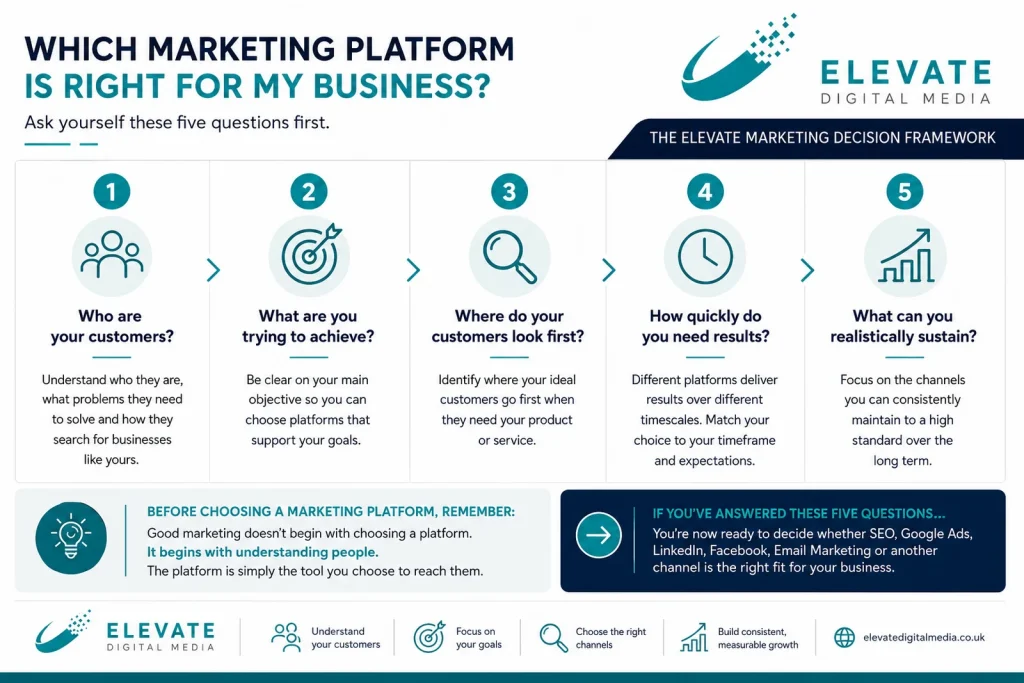
Before investing time or money in any marketing platform, ask yourself these five questions:
What can you realistically sustain?
Who are your customers?
What are you trying to achieve?
Where do your customers look first?
How quickly do you need results?
Summary
Choosing the right marketing platform is not really about platforms at all; it is about understanding your business. Once you understand your customers, your objectives, your timescales and the resources you can realistically commit, the choice of marketing channels becomes much clearer.
Good marketing doesn’t begin with choosing a platform. It begins with understanding people. The platform is simply the tool you choose to reach them.
Your Digital Marketing Toolkit
Every platform has a purpose. The key is knowing when to use each one.
By now, we’ve established that there isn’t a single “best” digital marketing platform. The right choice depends on your customers, your objectives and the resources you can realistically commit.
Think of each marketing channel as a tool rather than a competitor. Just as a carpenter chooses different tools for different jobs, successful businesses choose marketing channels based on what they are trying to achieve.
The strongest marketing strategies rarely rely on a single platform. Instead, they combine the right tools to help customers discover your business, build confidence in your expertise and take the next step when they’re ready.
Let’s start with the foundation of your digital marketing.
Your website
The foundation of your digital marketing
Your website is much more than an online brochure.
For many businesses, it’s where potential customers decide whether to make contact. Whether someone discovers you through Google Search, Google Business Profile, LinkedIn, Facebook, an email campaign or a Google Ads advert, there’s a good chance they’ll visit your website before deciding.
A well-designed website should clearly explain who you are, what you do, who you help and how someone can take the next step. Unlike social media platforms, it’s a space you own and control, making it one of your most valuable marketing assets.
Ask yourself
If someone visited our website today without knowing anything about our business, would they understand within a minute what we do and how to contact us?
Elevate’s Perspective
We see a website as the foundation of your digital marketing rather than just another marketing channel. Every other activity should support it, helping potential customers arrive informed, reassured and ready to take the next step.
Google Business Profile
Helping local customers find and trust your business
For many local businesses, the customer journey begins on Google rather than on their website.
When someone searches for a service in their local area, Google Business Profile helps them quickly understand who you are, where you’re based, what services you provide and what previous customers think of your business. For businesses serving a defined geographical area, it can be one of the first opportunities to create a positive impression.
Keeping your profile accurate, responding to reviews and sharing up-to-date information helps customers make informed decisions and supports your wider online presence.
Ask yourself
If someone found our business on Google today, would they have enough confidence to contact us before even visiting our website?
Elevate’s Perspective
Google Business Profile works best when it complements your website rather than replacing it. Your profile helps people discover your business; your website helps them decide whether you’re the right choice.
Search Engine Optimisation (SEO)
Helping customers find you when they’re already searching
Search Engine Optimisation (SEO) is the process of improving your website so that it can appear more prominently in search results when people are looking for products or services like yours.
Unlike advertising, you don’t pay each time someone clicks on your website. Instead, SEO focuses on earning visibility by creating helpful, relevant content, providing a positive user experience and making it easy for search engines to understand your website.
SEO is rarely a quick fix. It is a long-term investment that rewards consistency and quality. For businesses prepared to invest in building their online presence over time, it can become one of the most sustainable sources of enquiries.
Ask yourself
Are our customers actively searching online for the products or services we provide, and are we prepared to invest consistently in improving our visibility over time?
Why it matters
SEO isn’t simply about improving rankings. It’s about helping the right people discover your business when they already have a need. Done well, it builds visibility, trust and authority that continues to deliver value long after individual pieces of content have been published.
Google Ads (Pay-Per-Click)
Reaching customers when timing matters
Google Ads allows businesses to appear in Google’s sponsored search results for relevant keywords.
Unlike SEO, which takes time to build, Google Ads can help businesses gain visibility more quickly. This makes it particularly useful when launching a new service, entering a competitive market or generating enquiries within a shorter timeframe.
Google Ads works best when it forms part of a wider marketing strategy rather than being viewed as a replacement for SEO. Many successful businesses use paid advertising to generate immediate visibility while continuing to invest in long-term organic growth.
Ask yourself
Do we need to increase visibility quickly, and do we have a clear plan for managing and measuring our advertising investment?
Why it matters
Google Ads offers speed and flexibility, but successful campaigns require ongoing management, testing and optimisation. Used thoughtfully, it can complement rather than compete with your long-term marketing efforts.
Email Marketing
Staying connected with the people who already know you
While many marketing channels focus on attracting new customers, email marketing helps you build relationships with the people who have already shown an interest in your business.
Whether you’re sharing helpful advice, promoting a new service or keeping customers informed, email provides a direct way to communicate with people who have chosen to hear from you.
For many businesses, retaining existing customers can be just as valuable as finding new ones.
Ask yourself
Are we making the most of the relationships we’ve already built with our existing customers?
Why it matters
Unlike many digital platforms, your email list is something you build and manage yourself. Used responsibly, email marketing can strengthen customer relationships, encourage repeat business and keep your organisation front of mind.
Building professional relationships and demonstrating expertise
LinkedIn is designed for professional networking and business conversations.
For organisations that work with other businesses, decision-makers or professional audiences, it provides an opportunity to share expertise, build credibility and develop meaningful connections over time.
Rather than focusing solely on selling, successful LinkedIn activity often centres on helping, educating and demonstrating experience.
Ask yourself
Are the people who make buying decisions for our business likely to spend time on LinkedIn?
Why it matters
LinkedIn works best when you consistently share useful knowledge and engage with your professional community. Trust is built through expertise rather than promotion.
Building familiarity within your local community
Despite the growth of newer platforms, Facebook continues to play an important role for many local businesses.
It provides opportunities to share updates, celebrate customer success, engage with local communities and keep existing customers informed about your business.
For organisations serving local areas, Facebook can complement your website and Google Business Profile by helping people become more familiar with your business over time.
Ask yourself
Does Facebook reflect the way we want our business to be seen by our local community?
Why it matters
People often choose businesses they recognise and trust. Consistent, authentic communication helps build that familiarity.
Showing your business through visual storytelling
Instagram is particularly effective for businesses where strong imagery helps customers understand the value of what you do.
Whether you’re showcasing completed projects, hospitality, retail products, interiors or creative work, high-quality visual content can help potential customers imagine working with your business.
Ask yourself
Would seeing our work help customers understand the quality of what we offer?
Why it matters
Instagram isn’t essential for every business, but where visual presentation influences buying decisions, it can become a valuable part of your marketing mix.
TikTok
Sharing authentic, short-form content
TikTok has become a significant platform for short-form video and discovery.
For some businesses, particularly those with engaging visual content or educational demonstrations, it offers opportunities to reach new audiences through authentic and creative storytelling.
However, it also requires regular content creation and may not suit every organisation or target audience.
Ask yourself
Can we consistently create short-form video content that our audience would genuinely find useful or engaging?
Why it matters
TikTok is a powerful platform for the right business, but it shouldn’t be adopted simply because it’s popular. As with every marketing channel, the question is whether it helps you reach the people who matter most to your business.
Why it matters
TikTok is a powerful platform for the right business, but it shouldn’t be adopted simply because it’s popular. As with every marketing channel, the question is whether it helps you reach the people who matter most to your business.
Summary
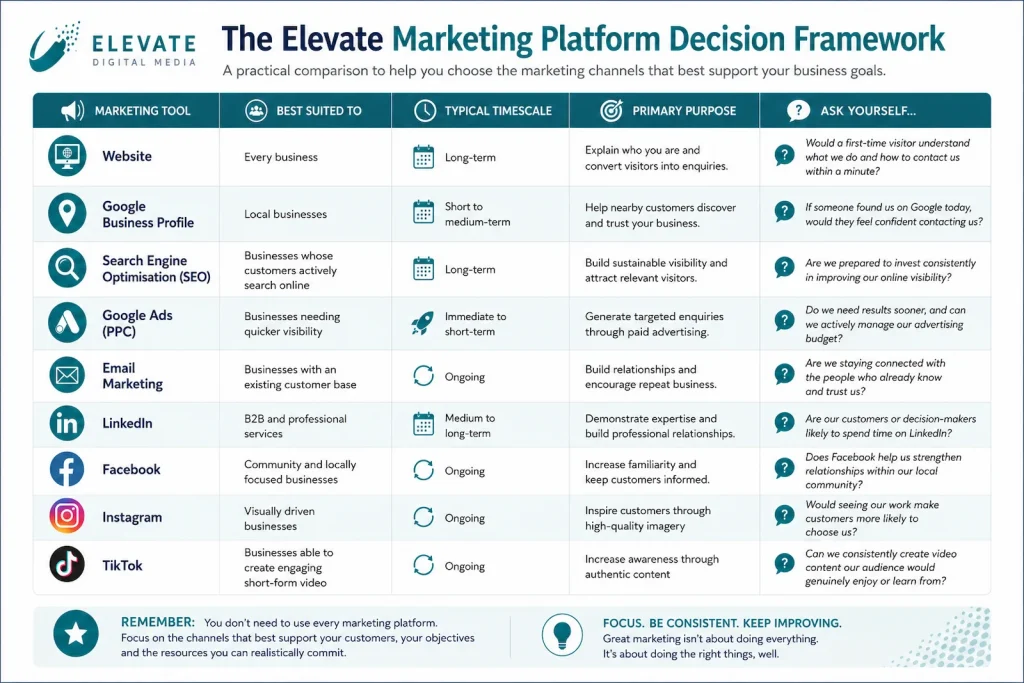
Which Marketing Tool Is Right for Your Business?
By now, you’ve seen that every marketing platform has a different role to play. The table below isn’t designed to tell you which platform is “best”. Instead, it’s intended to help you decide which tools are most likely to support your business goals.
One Important Thing to Remember
No business needs to use every marketing platform.
In fact, trying to be active everywhere often spreads time and resources too thinly.
The strongest marketing strategies usually focus on a smaller number of well-managed channels that work together to support clear business objectives.
Start with the platforms most likely to help your customers discover, understand and trust your business. As your confidence, resources and marketing maturity grow, you can then consider expanding into additional channels where they genuinely add value.
✦ Elevate Practical Takeaway
If you’re not sure where to begin, don’t ask “Which platform is best?”
Instead, ask yourself:
✓ Where are my customers already looking?
✓ What am I trying to achieve?
✓ Which marketing tool best supports that objective?
✓ Can I maintain it consistently?
When you can answer those questions confidently, choosing the right marketing platform becomes much easier.
Where Should You Start?
A practical roadmap for building your digital marketing with confidence
One of the biggest misconceptions in digital marketing is that successful businesses are active on every platform. Many successful businesses achieve their results by doing fewer things but doing them consistently and doing them well.
If you’re feeling overwhelmed, you’re not alone. You don’t need to master every marketing channel or launch everything at once. In fact, trying to do too much too soon often leads to inconsistent results and abandoned projects.
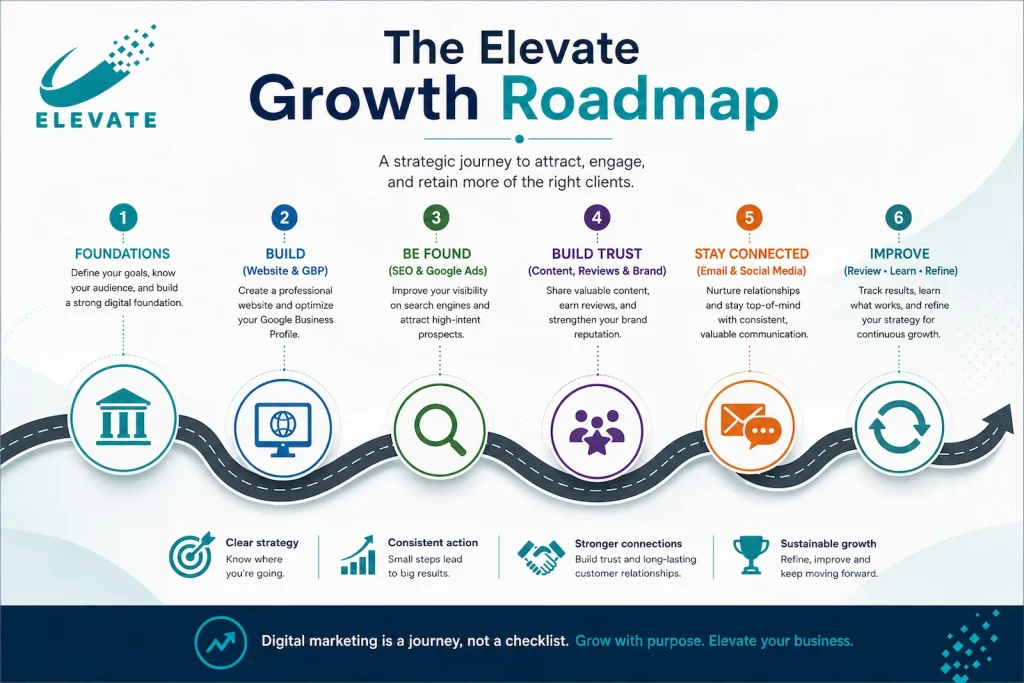
A better approach is to build your digital marketing strategy in stages, creating a strong foundation before expanding into new channels.
Think of it like building a house. You wouldn’t start with the roof. Digital marketing is no different.
Build
Start with strong foundations
Before investing heavily in marketing, make sure your business is ready for new visitors. That means having a website that clearly explains who you are, what you do and how customers can contact you. It also means keeping your Google Business Profile accurate and up to date, ensuring that customers can quickly find the information they need.
Ask yourself
If twice as many people discovered our business tomorrow, would we be ready for them?
Why it matters
Marketing works best when the destination is just as strong as the journey.
Be Found
Help customers discover your business
Once your foundations are in place, focus on making it easier for potential customers to find you. For many businesses, this means improving their website content, strengthening their local visibility and helping search engines understand the products or services they provide.
The goal isn’t simply to increase website traffic. It’s to attract the right visitors at the right time.
Ask yourself
How would someone who has never heard of us discover our business today?
Why it matters
If people can’t find your business, they can’t choose it.
Build Trust
Give customers confidence to choose you
Being visible is only part of the journey. People also need confidence that you’re the right business for them.
Clear information, genuine customer reviews, useful content, professional branding and a positive user experience all help build trust before someone even makes contact. Every interaction either strengthens or weakens that confidence.
Ask yourself
What would reassure a first-time visitor that we’re the right business to help them?
Why it matters
People don’t just buy products or services. They buy confidence in the people providing them.
Stay Connected
Build relationships, not just enquiries
Marketing doesn’t end when someone becomes a customer. Keeping in touch through appropriate channels, such as email marketing, helpful updates, or relevant social media content, helps strengthen relationships and encourages repeat business.
Existing customers already know your business. Looking after those relationships is often just as valuable as attracting new ones.
Ask yourself
How are we staying connected with the customers who already trust us?
Why it matters
Long-term growth is built on lasting relationships.
Improve
Keep learning and refining
Digital marketing isn’t something you complete. It’s something you improve.
Review what’s working, understand what isn’t and continue making small improvements over time. Technology will change. Customer expectations will change. Your business will change.
The businesses that continue learning and adapting are often the ones that achieve the most sustainable success.
Ask yourself
What’s one improvement we could realistically make this month?
Why it matters
Consistent improvement almost always outperforms occasional bursts of activity.
Summary
Successful digital marketing isn’t about doing everything. It’s about doing the right things, in the right order, and improving them over time.
Build strong foundations. Be easy to find. Give customers confidence. Stay connected. Keep improving.
Small, consistent progress is often the most sustainable route to long-term growth.
✦ Elevate Practical Takeaway
If you’re wondering where to begin, don’t try to launch five new marketing initiatives next week.
Instead, ask yourself:
✔ Is our website ready?
✔ Can customers easily find us?
✔ Do we inspire confidence?
✔ Are we building lasting relationships?
✔ What’s our next small improvement?
Answer those five questions honestly, and you’ll have a practical roadmap that is far more valuable than chasing every new marketing trend.
The Elevate Growth Roadmap brings together everything you’ve read in this guide into a simple journey you can follow, helping you build your marketing in the right order rather than trying to do everything at once.
Bringing It All Together
If you’ve read this guide from beginning to end, you may have noticed something.
We haven’t tried to tell you which digital marketing platform is “best.”
That’s because there isn’t one.
Every business is different. Your customers, your goals, your budget and the time you can realistically invest will all influence the decisions that are right for you.
The most successful businesses don’t usually grow because they chase every new marketing trend. They grow because they understand their customers, build strong foundations and make consistent improvements over time.
If there’s one idea we’d like you to remember, it’s this:
Good marketing doesn’t begin with choosing a platform. It begins with understanding people. The platform is simply the tool you choose to reach them.
Whether you decide to focus on improving your website, strengthening your Google Business Profile, investing in SEO, exploring Google Ads or building stronger customer relationships through email marketing, the most important thing is to start with a clear purpose.
You don’t need to do everything today.
Choose one area where you can make meaningful progress.
Do it well.
Measure the results.
Learn from the experience.
Then build on it.
Small, consistent improvements almost always achieve more than trying to transform everything at once.
Digital marketing isn’t a destination. It’s an ongoing process of understanding your customers, improving their experience and helping the right people discover your business.
Start with people.
Everything else becomes much easier.
The best marketing decisions are rarely the most complicated. They’re usually the ones built on a clear understanding of your customers and a commitment to improving consistently over time.
✦ One Question Before You Leave
If you could improve just one aspect of your digital marketing over the next three months, what would have the biggest positive impact on your business?
That is probably the best place to start.
About Elevate Digital Media
At Elevate Digital Media, we believe that good marketing should help business owners make better decisions, not leave them feeling overwhelmed.
We work with small and medium-sized businesses to create practical, sustainable marketing strategies built around their goals, their customers and the way they want to grow.
If this guide has helped you think differently about your marketing, we’ve achieved exactly what we set out to do.
Need help deciding which marketing channels are right for your business?
We’d be happy to help you build a practical marketing strategy based on your goals, your customers and your budget. Get in touch to arrange an informal conversation.
There will always be a new platform, a new trend or a new technology promising faster results. While it’s important to stay curious and embrace innovation where it genuinely benefits your business, the fundamentals rarely change. Businesses that understand their customers, communicate clearly and continue to deliver value will always be in a stronger position than those chasing the latest trend without a clear purpose.